FBCWest 733 | A Foolish Order
Recorded On: 10/11/2026
Bulletin
Hymn # 290 “Make Me a Blessing”
SCRIPTURE READING – Psalms 111
Giving of Selves and Our Offerings
OFFERTORY PRAYER
OFFERTORY MUSIC – Pru Hungate
Praise and Worship
“Jesus Saves”
“God So Loved”
“Your Love Awakens Me”
Proclamation of the Word
Message by Pastor Joe
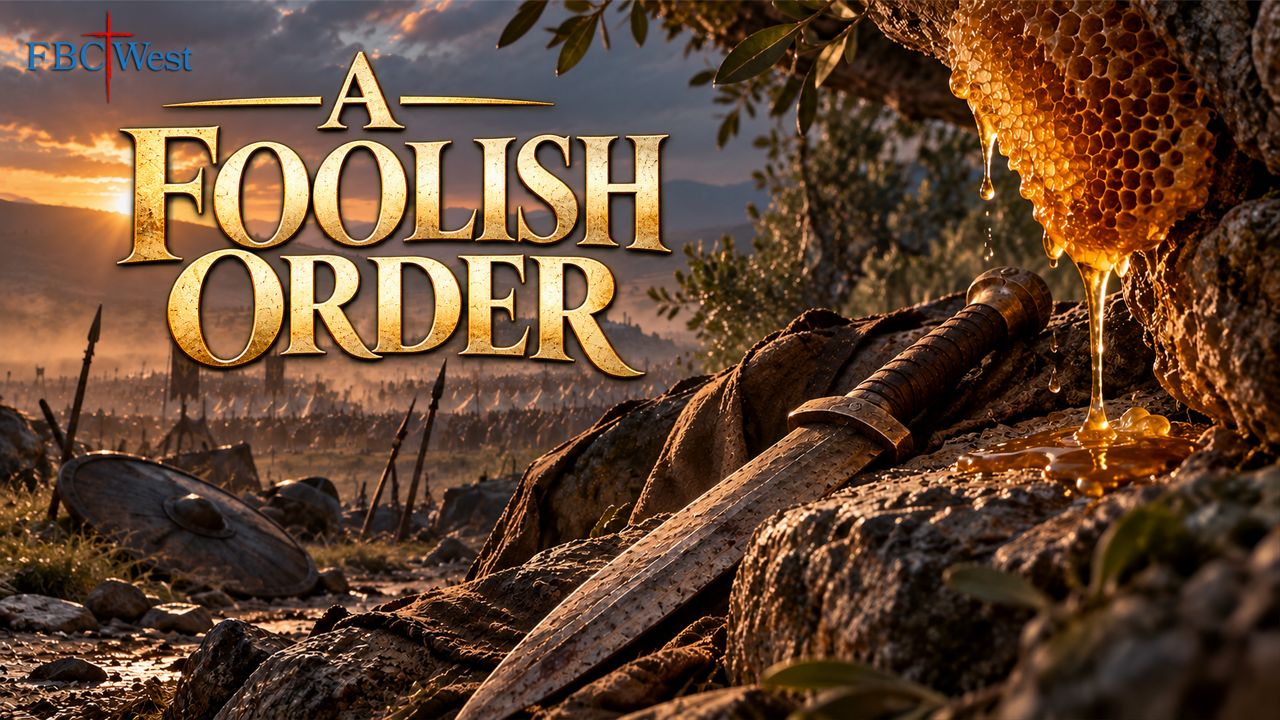
“A Foolish Order”
PRAYER TIME / Time of Reflection
“This Is Amazing Grace”
Acknowledgements and Announcements
Sermon Notes
1 Samuel 14:24 Saul orders no one eat that day
1 Samuel 14:25 & 26 Forest flowing with honey, but no one ate
1 Samuel 14:27 Jonathan not knowing of the order, eats honey and was strengthened by it
1 Samuel 14:28 – 30 Jonathan told about the order and says the victory could have been greater if the people had eaten
1 Samuel 14:31 – 33 After the victory the people slew a number of animals and ate before the blood had been drained
1 Samuel 14:34 & 35 Saul has the people make a sacrifice for their sin and he built his first alter
1 Samuel 14:36 & 37 Saul inquires of the Lord, but the Lord does not respond
1 Samuel 14 – 42 Jonathan determined to be the one who violated Saul’s order
1 Samuel 14:43 – 46 The people intervene on behalf of Jonathan
Scritpures
Transcript of Service
Most of us, if not all of us, have had foolish thoughts. The important thing is the thoughts turn into foolish actions. We're going to take a look at King Saul, who makes a foolish order and the consequences that emanate from that foolish order. We're going to take a look at what he didn't do and what he should have done in order to avoid that foolish order so that we don't make this. Now, the men of Israel were hard pressed on that day for Saul had put the people under oath saying, curse it be the man who eats food or evening and until I have avenged myself on my enemies. So none of the people tasted food. I want to stop there.
This is where the order is foolish. I want to say the other word. This is the commander of an army. He also has previous experience, not only as a warrior, but as a father. We're told that Jonathan is his son and Jonathan is a warrior in fighting.
We also told later that he has two other sons, a couple of daughters. Now, any father, any parent knows that young men, especially teenagers, eat a lot. They want to consume you out of your house because they just eat. But that when they are active, then they eat even more.
And so, for instance, I have two teenage grandsons. They eat a lot. Their father and my son, when he was a teenager, ate a lot. I remember back in the day, everybody would say, don't you want something more than a hamburger?
And then when they start eating steak, you go, let's go back to hamburgers. There's a lot cheaper. But you understand that they consume a lot. But when they are active, my two grandsons play football and basketball. So they consume even more food.
And their parents are wise enough to know that on really active days, like when they have a game or when they have extra practice, they'll even have two dinners. And protein shakes and all those types of things. Because the activity that they're going to participate in is going to require a lot of calories. I suspect, though, I've never been in battle, that battle requires a lot of physical effort, especially when you're talking about in the days of swinging and sores and all. It takes a lot of physical strength. On top of that, it's one thing to be nervous when you're in competition.
I'm sure it's quite even more nervous if you're thinking you could die. And nervous energy takes up a lot of calories as well. So, sores by experience with these children that making this order was foolish. If you wanted to say that other word was foolish. We even know in our military that they say that our military goes to war on their bellies. Now, they're not talking about crawling on their bellies.
They're talking about that they need food to eat, to battle, to fight. And so we try to provide, other than I guess, MRIs, the best kind of food so that they are physically ready, the physical or deal that will require. But instead, what does Saul do? He says, don't eat. Turn a time of battle, not wise.
Second mistake Saul makes is that notice he takes it personal as until I have a bench by self on my enemies. They're only his enemies because they're God's enemies. And God is the one who's going to win the battle. The God is the one who has won the battles previously. And God is going to be the one who's going to win the battles in the future. He takes it upon himself to be personal. They're my enemies.
No, they're God's enemies. Trust God. So he says so the people respond because he's king and they're concerned about his retribution.
And all the people of the land entered the forest and there was honey on the ground, which is interesting because remember when God promised Israel to them, he said, this is a land flowing with milk and honey. There's so much honey that is on the ground. It's not even beehives. It's in on the ground. You don't even have to harvest it. You just dip it and take it.
So it's plentiful. It would have assisted them, but they couldn't eat. And when the people entered the forest, be hold. There was a flow of honey, but it's hand to his mouth for the people feared the oath. They took their oath seriously.
You would be cursed if you ate, so we're not going to eat. But Jonathan had not heard when his father fought the people under oath. Why fighting God's enemies, fighting Saul's enemies, setting up a situation where God could deliver them from their enemies, but he hadn't heard it because he was out there behind enemy lines. Therefore, he put out the end of the staff that was in his hand, dipped it in the honeycomb, and put it his hand to his mouth and his eyes right in. There are a lot of scriptures I wish I could identify with. This one, I remember there was a time when I was younger, that I was hungry. I ate something.
I don't remember what it was, but I physically felt my eyes right in. And I remembered this verse that sometimes not only does your move get affected by your lack of food, or even your energy, but your whole can brighten your eyes light up. You can see better, you can understand better. So because he had done this, his eyes brightened. Then one of the people said, your father strictly put the people under oath, saying, curse it be the man who eats food today, but we're weary, because they had an eaten. They've been fighting the enemy, they've been waiting to fight, they've been fighting. They're now pursuing the enemy, and they're tired.
And all of the, if they would have been able to take some of this honey, they didn't just like Jonathan, but they couldn't because of the king's foolish order. Then Jonathan said, by father-wrestled the land, see now how my eyes have brightened because I tasted a little of this honey. Now, it doesn't surprise me that Jonathan being the son of Saul, criticized his dad because that's what a lot of sons do.
But Jonathan is right here. His father was the problem. If they allowed the people to at least taste some honey, they would have been so weary and could have done further.
How much more if only the people had eaten freely today of the spoil of their enemies, which they found for now the slaughter of things has not been great. So we're going to see one of the consequences later, but there's two consequences by the king's order. First, the people are weary, they're tired. But because they're weary and tired, they don't have a complete victory. They only have a partial one. They could have further devastated the Philistines. But because they lacked the energy, because they lacked the ability to take on more calories, they couldn't pursue them. And so the problem again is the enemy could feed it.
But instead, now the enemy will be able to fight another day because of this order. So when you think about foolish things, think about the consequence. I mean, that will help you not to take a foolish thought and put it into a foolish action. But this is not the only consequence that happens. And they struck among the Philistines that day from Mishmash to Agile On were very weary.
And the people who rushed really upon the spoil and took sheep and oxen and calves and slew them on the ground and the people ate with a blood. Consequence number two. And this is even a greater consequence, not the defeat the enemy.
The consequence of creating a situation where the people will sin. Now it does not say that they ate the blood, which is a violation. But what they are supposed to do is make sure that the blood is drained, that they're going to eat. But because they're so famished and hungry, they can't allow the normal processing of the food that they should.
The food should be allowed to drain from the blood. And then therefore then they could butcher it, cook it, and do all those types of things. So for instance, if you go to a steakhouse and you order like I do, medium rare.
And you cut the steak sometimes, it looks like it's bleeding. That's not the blood. It's already been drained. Don't have to worry. You're not violating that scripture. But the problem with food had not drained when they're eating the meat, they're eating the blood in the meat. And that is a violation of God's command. So not only is the consequence that they not totally have victory over the enemy, is now allowed a situation where the people say, because they're so hungry, they can't wait to prepare the food properly.
And so then they told Saul saying, the whole of the people are sitting against the Lord by eating with the blood. And he said, you have acted treacherously. Roll a great stone. They acted treacherously because of what he did. His decision set that course that they might have an opportunity to send. Sometimes we think our actions seem innocent in and of themselves. Set up a condition for not only maybe we sin, but we allow and permit others to.
Secular people will tell you what you should do when you're trying to make a decision. Is you write down the pros and you write down the. And you try to balance it out and they'll say, well, if the cons are more than the pros, then don't do it. Well, sometimes you may have more pros and cons, but the cons are really bad. Maybe you have one con and 18 pros, but if that one con is really bad, it's a foolish decision.
So not only does Saul not take into account his life experiences with his children, he sets a condition where people do sin. When if he would have what are the possible consequences of the people not eating, this might have been one. So maybe he wouldn't have made that decision.
So now he's going to be the great spiritual person. The people are who cause them to sin. The people are sinning. And so we're in the stone so that I can create an author so we can do these things. And so said this. Dispersion yourselves among the people and say to them each one of you bring me his.
Or a sheep and slaughter it here and eat. And they. Do not sin against the Lord by eating with the blood.
So all the people that night brought each one is ox with him and slaughtered it there. So now they take where they head sin and they do in essence the same thing. They slaughter the animal to give it to God, asking that God forgive them their sins because of the sacrifice. And that God will now not be unpleased with them.
And so he built an author to the Lord. It was the first altar that he built to the Lord. What did not have been a better altar. He built an altar to the Lord saying, you gave us this wonderful victory. And we're going to market. By that you won our battle against an enemy. And he built an altar because the people sinned.
And so said let us go down after the Philistines by night and take. Until the morning light and let us not leave a man of them. And they said do whatever seems good to you.
So the priest said let us draw near to God here. So the people say if that's the king's order. That's what you want to do.
Now that we've had a chance to nourish ourselves to our bodies with the calories that we need. If that's what you want to do, we'll do it. And then the priest said let's figure out what God wants us to do. Let's draw near to God because God was the one who gave them the victory. So required of the God. And after the Philistines, we'll give them into the hand of Israel.
But he did not answer him on that day. Notice, Saul is an interesting contrast. He couldn't wait for Samuel to show up in the previous messages. So he did his own sacrifice.
And then when Jonathan had gone into the enemy lines and was fighting the enemy and they were winning, he kept delaying and delaying and delaying. And now it's God's day. Maybe, maybe because God says no. Maybe when God is silent, it's not because he's saying we'll see maybe he's doing that. Or maybe the answer is no. He just remains silent. Or maybe the answer is not yet. Wait upon the Lord.
But that's when he should be a man of action. He's a man of patience. He seems to be a man of action. Saul said, drawn near here. All you chiefs of the people and investigate and see how this sin has happened today. You don't need an invention.
You made a foolish order. I want to say the other word. You made a foolish order. That's the reason the people are in the situation they're in. For us, who delivers Israel through it is in. It is in Jonathan, my son. He's one of all the people answered him.
He makes a boast. If the guilty culprit is my son, he's going to die. I want to make the man who calls this to suffer the penalty of death. As the people know who violated Saul's order. Saul is real. You shall be on one side and I and Jonathan, my son, will be on the other. And the people said to Saul, do what seems good to you. So basically saying, when we're going to set all the people on one side, we're going to see if Jonathan and me on one side, we're going to see if it's our fault.
Therefore, Saul said to the Lord, the God of Israel, give a perfect lot. And Jonathan and Saul were taken with the people of the state. So now the guilty has been to not the people, but either Saul or Jonathan. And Saul said, cast loss between me and Jonathan, my son, and Jonathan was taken.
Then Saul said to Jonathan, tell me what you have done. So Jonathan, I indeed tasted a little honey with the end of the staff that was in my hand. Here I am, I must die. Now talk about a loyal son. The king said something foolish.
Jonathan never heard it. He did the order purposely. But he said, even though I didn't hear it, I'll pay the consequence. In an offer excuses, he said, wait a minute. Remember when guys in the forest, remember when I said it was because the problems. He didn't cast his versions on his father's leadership. I'll pay the consequence.
It kind of reminds me of the son of God who said, I didn't sin. You did. But I'll pay the content. Saul said, may God do this to me and more also, for you shall surely die, Jonathan. They love this.
If I don't do this, then may God do it to me the same. Maybe you should just be quiet. And then carry out your words there. I have to ask, can you solve Jonathan? But again, he continues making foolish statements. But the people said to Saul, must Jonathan die. Who's brought about this great deliverance in Israel?
Far from it. As the Lord lives not one hair on of his head shall fall to the ground, for he has worked with God this day. So the people rescued him and he did not die.
The people stood up and said, Jonathan was the one who led us, who trusted God, who God delivered, because if it had what had been for Jonathan, maybe we still would be in this struggle. Jonathan did so initially what he did. He should not die. Nothing, no harm to come. Not even a hair from his head should fall. The people rest you in.